
As my journey into cognitively guided instruction for math continues, I’m not only participating in a book study, but I’m also trying to implement the things that I’ve been learning with my students. I’d like to take some time today to analyze some student work.
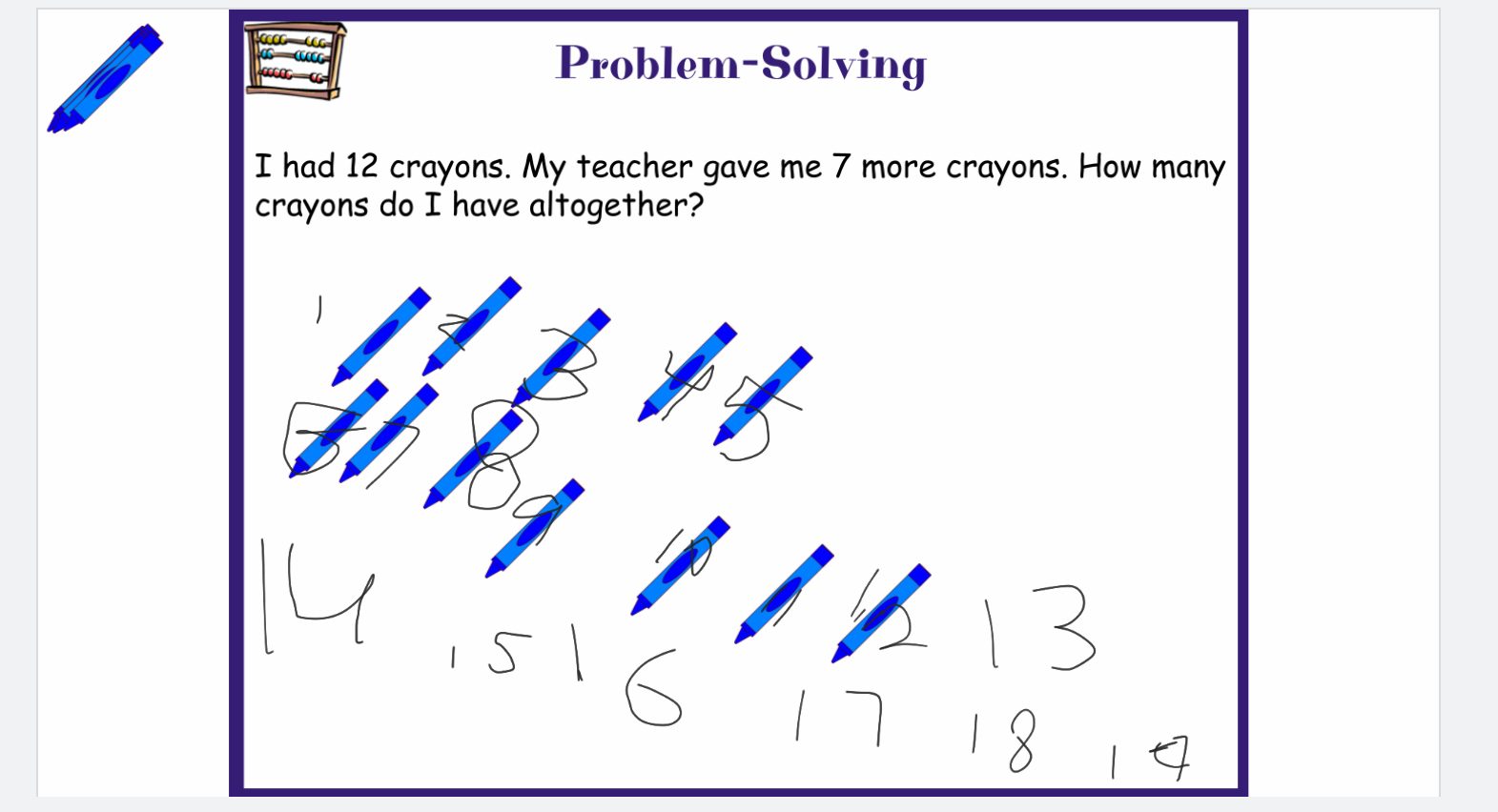
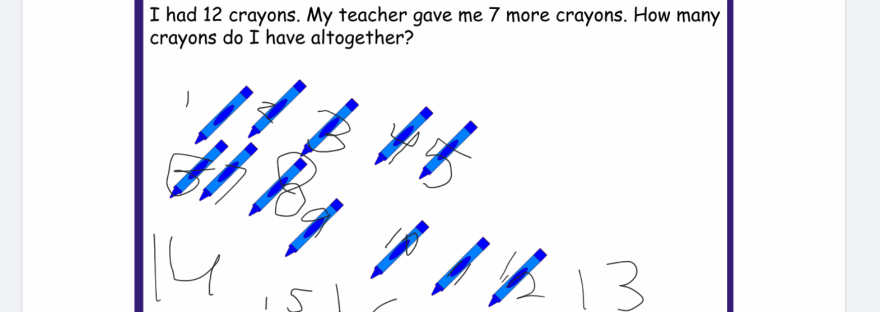
The example above is from a first grade student. The problem is a Join, Result Unknown type. In this problem, the addends are known, and the sum is not. I chose a number set that I hoped would push the student to use a direct modeling or counting strategy. On the surface, this seems to be a fairly straight-forward problem. But, I’m learning that there is nothing straight-forward about teaching math. Students will always surprise you with the way they choose to solve problems!
To begin, I had my student read the problem silently to herself. I followed by having her read the problem aloud to me. We talked about what information the problem gave us. I asked my student how many crayons does the person in the problem start out with. She answered, “12,” and I pointed out that there were some crayon counters that she could use to help show twelve crayons. She moved twelve crayons onto the board. We discussed how mathematicians verify their work, and she labeled the counters to show she was accurate in moving twelve crayons into the workspace. We then discussed what happened next in the story. She told me that the teacher gives seven more crayons. I asked her how she could show that part of the story. I was expecting her to move seven more counters onto the board, but she chose to just write down the numbers. She chose to count on seven more from twelve until she reached nineteen.
I followed up by asking her if she could show what she did with a number sentence or equation. I knew that this was something she was practicing with her first-grade class. I had reviewed homework with her that was a series of equations meant to help her memorize her math facts. Surprisingly, she told me she didn’t know how to show me. So, I do see that this particular student has not made the connection between the standard algorithm and problem-solving. That’s what makes this CGI journey so fascinating — guiding students to put these puzzle pieces of knowledge together!
Someone who is more developed in their CGI math knowledge could probably see a lot more that could be analyzed in this student sample. I just wanted to share where I am in my journey in guiding students to be problem solvers. I would love for us to have a conversation and share our wisdom and experiences in teaching math. Please feel free to leave a comment below.
Until next time… Happy Teaching!


 PinaRose Education
1 thought on “CGI Book Study: Analyzing Student Work”